

Faces of Bodywork: Leslie DeJesus
Leslie DeJesus's Afro-Caribbean background played a role in her becoming a massage therapist.
Massage & Bodywork: Can you share the journey that brought you to where you are today?
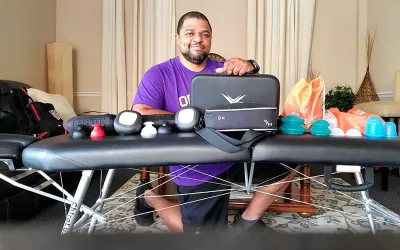
Desmond Diaz: Before massage, I was in school for computer programming and computer graphics. It was fun but not very fulfilling. I was also working as a rehab technician for a physical therapy company at the time, and my mother thought I should go to school to be a PT. I wasn't interested because I felt helping people in those settings was limited by too many factors. [Then] at my mother's house, I saw a book on massage therapy, and once I started reading it, I was hooked. After discussing it with my coworkers, who agreed it would be a good fit, I went [to school]. After school, I worked with marathon expos, small sporting events, chiropractors, then pro athletes/teams. Now I have my own practice and work with a physical therapy clinic in Kent, Washington.
M&B: What is it like working with athletes across so many disciplines?
DD: It's always exciting and a fun challenge! Each sport has unique needs and team dynamics; additionally, each athlete brings things such as player position, known issues outside of the sport, goal for sessions, etc. I have gained so much understanding working with so many teams and am grateful to work with diverse and eclectic groups of athletes.
M&B: Your background includes martial arts training. How has that contributed to your massage work or helped you as a practitioner?
DD: Martial arts provided me with such a strong base in many ways. It gives me the physical strength, balance, and body mechanics to perform massage on varying body types. As a martial artist who has been in competitions and had their share of injuries (torn ACL, ruptured Achilles), I have a lot of experience with the competitive side of things and the recovery journey, and that helps provide perspective to those I work with.
M&B: Can you tell us what things you do for fun?
DD: I really enjoy traveling (out of the country), learning new skills, martial arts training, video gaming, watching movies, reading, and spending time with close friends.
M&B: Who is someone you look up to?
DD: Wow, that's tough, mostly because I don't look up to singular people, but I'll split this into professional and nonprofessional. Professionally, Paul Kelly and Rob and Sherry Routledge. I've learned so much from them. They motivate me to be better. Outside of that, my mom, and my karate instructor, Armando Colbourne Sr., are the ones who made me who I am.
M&B: What is something you wish people knew about you?
DD: I can be seen as aloof and humorous for the most part, but it's based on caring. I'm passionate about making sure every client gets the best treatment I can put together. If I can't help, I will try just as hard to help you find the person you need. My concern for [my clients] usually follows me home. My goals are always to get people to care about their well-being more than I do.
Leslie DeJesus's Afro-Caribbean background played a role in her becoming a massage therapist.
To align your practice with your passions, values, and strengths, create your idea of the perfect client who describes your niche.
Negotiating can be nerve-racking for many people. These five strategies can help you prepare for your next negotiation or business contract.
Learn how to integrate these systems to help you book clients and track your budget, income, growth, and returning clientele.