
Dance Stance
This variation of your massage stance can reduce discomfort, help conserve strength, and use your movement and body weight most efficiently during a session.
The bedrock of a robust massage therapy practice is always having a variety of treatment techniques. In particular, variety is integral to any treatment system that addresses musculoskeletal conditions. How to address each client's problem depends on the condition specifics, stage of recovery, and the client. Employing diverse treatment options that fit the condition and the client will lead to greater success with your clients.
One of the core systems in my Clinical Orthopedic Massage program is what I call the ladder of engagement (LOE). I developed this system to simplify and organize the diversity of treatment options you face when working with musculoskeletal disorders. The LOE system is a progressive application of techniques to make your treatments more specific and effective. The system allows the practitioner to customize each treatment for the condition and client. And it will help you customize the treatment to the condition and client's specific healing process.
The LOE system is valuable to help you move away from simple recipes and routines in your practice. It is an excellent approach to treating complex pain and injury conditions. It also applies in other settings and will expand your treatment options. In this article, we'll cover the general basics of the LOE system and look at a few examples. Please know that the following is a simplified and greatly abbreviated version of this system.
Before going into the LOE system levels, let's look at a core consideration you will face when applying the techniques. At each level or rung of the ladder, you will choose how much or how little of your hand surface to use and how much pressure to apply. How, why, and when to use a particular amount of pressure and hand surface is a critical component in treatment. The contact surface has a significant bearing on the physiological effects of the treatment.
Pressure and contact surface choices are key considerations at each level of your therapeutic plan. The amount of contact surface determines how localized or dissipated the pressure of your technique will be. A broad contact surface, like the palm of your hand, backside of your fist, or your forearm, spreads the pressure out over a larger area. As a result, the pressure and specificity of the force are more muted. Spreading the pressure out is highly beneficial in areas where pressure on the tissues produces pain, or in the early stages of an injury in which tissues are highly sensitive or should not sustain more pronounced pressure. Effleurage (gliding) is a common broad pressure application, for example.
Conversely, a smaller contact surface, like a fingertip, thumb, elbow, or pressure tool, concentrates pressure in a specific area and thus has a more penetrating effect. Small contact surface applications are most helpful with tissue-specific treatments. Trigger-point therapy is a good example.
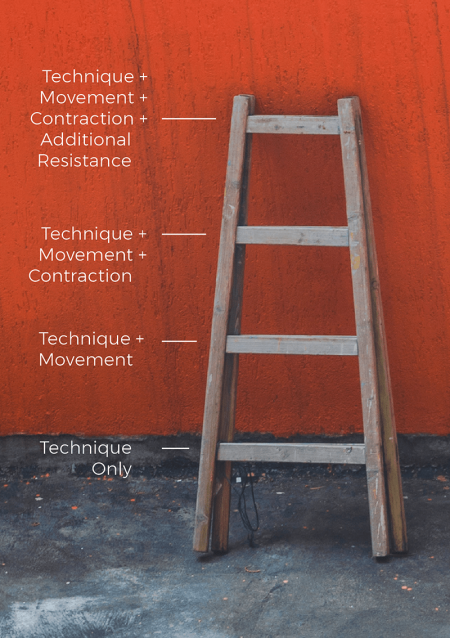
The ladder represents the increasing activity levels the therapist and/or client engages at each rung or level of treatment. Image 1 shows the four rungs of the LOE. At each level, neurological engagement and client involvement increase.
Technique Only is the first rung of the ladder. At this level, the practitioner applies only the technique, and there is no movement or action by the client. Level one includes most techniques practitioners use during their massage treatments. These techniques may be applied using a broad or small contact surface. The choice depends on the condition, the stage of healing, and the client.
Techniques that fall under this first rung of the ladder are generally effective for overall relaxation. They are especially effective with acute injuries or significant soft-tissue pain. The client is encouraged to fully relax and allow the practitioner to perform all the actions. Consequently, these techniques often induce the greatest degree of relaxation within the nervous system. Following are a few of the techniques used in level one.
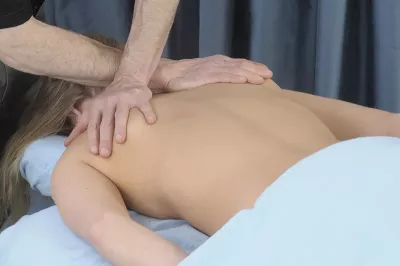
The second level or rung of the ladder is Technique + Movement. At this level, the practitioner incorporates passive movements of the client's limbs or body during the treatment technique. Adding passive movement along with the technique helps encourage tissue pliability. Movement also helps encourage proprioceptive awareness, which is the client's perception of their own movement. Increased proprioception is extremely helpful for regaining pain-free movement. Here are some examples of techniques that fall under the second rung of the ladder.
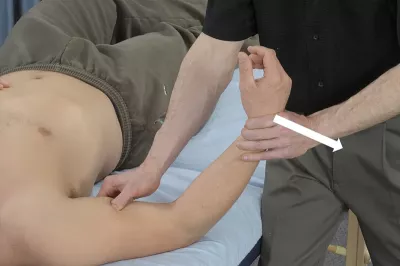
The third rung of the ladder is Technique + Movement + Contraction. A basic technique like those used at the earlier rungs is used at this level. Movement is also involved, but the client is actively participating. The contraction may be either concentric or eccentric. You will again choose between a broad or specific contact surface, depending on the intended result.
With an active muscle contraction, the muscle increases its density. Applying pressure with increased density allows the pressure to penetrate more directly under the contact surface. Consequently, the practitioner can get better penetration without using much force. An active contraction also engages greater neural activity, which is important in reestablishing healthy, functional, and pain-free movement.
The practitioner must understand kinesiology, and the main concentric and eccentric muscle actions, well to be most effective. Here are examples that incorporate technique, movement, and contraction.
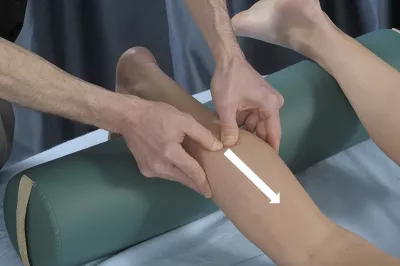
The top rung of the ladder is Technique + Movement + Contraction + Additional Resistance. This rung is an extension of the previous rung. The primary difference is that an additional load is put on the muscle during the contraction. The point of additional load is to recruit a greater number of muscle fibers. Recruiting more muscle activity mimics real muscle actions used during normal movements. A good understanding of kinesiology is necessary to use the appropriate muscle contractions. However, at this rung, the practitioner must not only recognize the primary muscle action, but also determine how to offer appropriate resistance to the muscle during the technique. Additional resistance that increases the muscle's load is usually done with resistance bands, handheld weights, or the practitioner's hands.
The techniques at this ladder rung are most effective during the later levels of rehabilitation or with highly active individuals. Because you are putting a load on the muscle and simultaneously applying pressure, these techniques can be the most intense of the different levels. As a result, you don't want to do this too early in the rehabilitative stage when certain treatment techniques may be painful or increase adverse neural activity. Here are some examples of techniques at the fourth rung of the ladder.
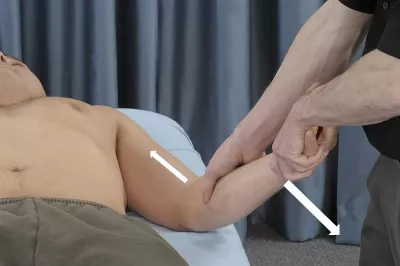
Practitioners should understand that these technique variations are not random alternatives to different techniques. There are specific reasons that should direct which rung of the ladder you choose. In the Clinical Orthopedic Massage system, I use another of my systems, called the rehabilitation protocol, as a guideline to determine a condition's severity level. The protocol also then guides the decision about what type of treatment strategies will be most effective.
In general, you will usually move up the ladder from level one to level four. However, there are cases in which you might jump up the ladder to other levels more quickly. I always recommend starting with level one to ease the nervous system and relax the client. But for some situations, such as with professional sports clients, jumping to level four after level one can be beneficial.
A great benefit of the ladder of engagement system is taking what you may already know as relatively simple methods and multiplying the variations on those methods to create dozens, if not hundreds, of new technique options. It is a simple but effective system that can become a hallmark of your therapeutic practice.
This variation of your massage stance can reduce discomfort, help conserve strength, and use your movement and body weight most efficiently during a session.
Caring for elderly clients requires the massage therapist to have a keen awareness, not only of the characteristics unique to the client but also of the various members of the client’s care team.
Changing muscle memory habits as they relate to mobility and movement can be hard. Luckily, you are there to help clients along so they aren’t forging a new path alone.
While tension-reducing techniques can help when issues arise from forward-head posture, addressing joint restrictions through manual therapy can prove more significant.